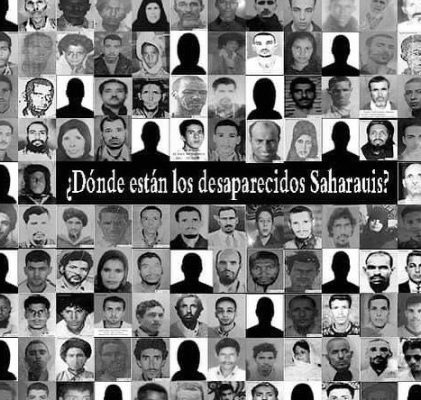
Within the framework of the commemoration of Saharawi Disappeared Day, the Association of Families of Saharawi Prisoners and Disappeared (AFAPREDESA) held a solemn official ceremony on June 18, 2026 at its headquarters in Wilaya Chahid El Hafed, with the aim of honoring the memory of the disappeared and strengthening the struggle for the rights of victims to truth, justice, reparation, and guarantees of non-repetition.
The event featured prominent institutional and social representation, led by Mr. Mohamed Mami Tamek, Minister of Occupied Territories and the Diaspora, as well as the participation of families of the disappeared from the occupied territories, members of the National Coordination Mechanism for Human Rights, survivor of summary executions Abba Ali Said Daf, and numerous human rights activists and defenders.
During the day, tribute was paid to Sidi Mohamed Basiri, the first Saharawi disappeared person, whose disappearance took place on June 18, 1970, under the exclusive responsibility of the Spanish state. Special emphasis was also placed on unresolved cases of enforced disappearances from the Francoist and post-Francoist period through to the most recent cases, including that of Lehbib Ahmed Hmiti (known as Lehbib Aghrichi), missing since February 7, 2022 in Dakhla, and the “Group of 15,” composed of young people abducted on December 25, 2005.
Tribute to families and especially to mothers and wives
In an emotional moment, special tribute was paid to the families of the disappeared, with particular recognition of Saharawi wives and mothers. They have carried for decades the unbearable weight of anguish and uncertainty, keeping alive the flame of hope and dignity despite the constant pain of not knowing the whereabouts of their loved ones. The participants expressed their deepest respect and gratitude to them, and called on them to continue their struggle with determination until the disappeared are found, alive or dead, and until truth and justice are achieved.
Key interventions:
- The testimony of Abba Ali Said Daf, who recounted his experience and denounced the executions that took place in Amgala on February 12 and 13, 1976, when Spain had not yet withdrawn from the territory.
- The intervention of Djimmy El Ghalia, human rights defender, former disappeared person, and daughter of the disappeared Fatimetu Baad. She presented the progress made in the file of Saharawi disappeared persons, resulting from the coordinated efforts of Saharawi organizations, particularly the Association of Victims of Grave Human Rights Violations Perpetrated by the Moroccan State and AFAPREDESA. She highlighted that both organizations have documented more than 400 cases submitted to the United Nations Working Group on Enforced or Involuntary Disappearances. In collaboration with the Hegoa Institute of the University of the Basque Country, the research work entitled “Oasis of Memory: Historical Memory and Human Rights Violations in Western Sahara” was carried out under the supervision of Professor Carlos Martin Berinstain. These actions of denunciation forced the Kingdom of Morocco to recognize, in December 2010, that 68% of cases of enforced disappearances that occurred between 1956 and 1999 in Morocco and Western Sahara concerned Saharawis, including 14 children.
- The statement of Ms. Enhbouha Boutenkiza, on behalf of the Mothers’ Committee of the Group of 15. She highly praised the committee’s efforts, but regretted that the Kingdom of Morocco continues to conceal the fate of the 15 young people abducted on December 25, 2005. The case remains open before the UN Working Group on Enforced Disappearances. She reaffirmed that the mothers will not cease their struggle until they know the truth and obtain justice.
- The intervention of Fanana Ahmed Hmiti (Aghrichi), on behalf of the family of the disappeared Lehbib Ahmed Hmiti. She recounted the dramatic events of February 7, 2022 in Dakhla: the last time he was seen entering the YA shop, the discovery of his abandoned vehicle, his arrest and subsequent suspicious release, and the discovery of his naked body on the beach with clear signs of torture. She denounced the contradictions in the Moroccan official version and the total absence of official evidence. The case was brought before the UN Committee against Enforced Disappearances under number AU 1537/2022, which demanded that the Moroccan State take urgent search and investigation measures.
Furthermore, the participants highly valued the findings of the first two mass graves at Fadret Leguia (Amgala, Smara region), where the remains of eight Saharawi persons — including two adolescents — executed on February 12, 1976 by the Moroccan army were exhumed. These events occurred while Spain was still acting as the administering power of the territory. The exhumation, anthropological-forensic identification, and genetic analysis work was carried out by a team from the University of the Basque Country and the Aranzadi Science Society, under the supervision of Professor Francisco Etxeberria Gabilondo. In relation to enforced disappearances, there are 15 potential mass grave sites, most of which cannot be exhumed as they are under the control of the Kingdom of Morocco.
Spain’s Responsibility
The participants recalled Sentence 40/2014 of the Spanish National Court, presided over by Magistrate Fernando Grande-Marlaska, which affirms that Spain remains the administering power of Western Sahara and, as such, has the obligation to protect Saharawi citizens against all abuse, even extending its territorial jurisdiction to guarantee such protection, in accordance with Articles 73 and 74 of the United Nations Charter. Likewise, they highlighted Sentence 1/2015 of Judge Pablo Ruz, which indicted eleven senior Moroccan military and civil officials for crimes of genocide in conjunction with illegal detention, torture, murder, and enforced disappearances committed against the Saharawi population, thus recognizing the systematic and serious nature of the violations committed.
Spain’s Responsibility and the Truth Commission:
The participants reiterated the historical and legal responsibility of Spain as the former Administering Power of Western Sahara, under Article 73 of the United Nations Charter. They demanded that the Spanish government fully assume its obligations, intensify political and judicial pressure on Morocco, and facilitate the conduct of independent investigations, as well as access for the International Committee of the Red Cross to mass graves.
They also welcomed the creation of the Truth Commission chaired by Judge Baltasar Garzón, considering it a fundamental step towards clarifying enforced disappearances and other serious human rights violations in Western Sahara. They urged the Spanish government to support its work and strengthen cooperation with this commission to move towards the authentic restoration of Truth for all victims, without discrimination or exception.
The participants renewed their demand to immediately clarify the whereabouts of all Saharawi disappeared persons, as well as to guarantee access to justice, accountability, and an end to impunity. They stressed that enforced disappearances constitute war crimes and crimes against humanity that are not subject to statute of limitations.
In this context, they issued a strong call to the families of the disappeared to resume with renewed strength their actions of denunciation and mobilization, to unite in a network of active solidarity, and to express their unwavering support for all victims and their loved ones. Only through unity and perseverance can the necessary pressure be kept alive to wrest the truth from those who conceal it.
Likewise, the participants made an urgent appeal to the international community to fully assume its historical and legal responsibility, and to act firmly so that both Spain and the Kingdom of Morocco reveal, without delay or excuses, the whole truth about the cases of Saharawi disappeared persons. They demanded that international bodies, the United Nations, and global civil society redouble their efforts to end impunity and complicit silence, and so that justice may finally become a reality for all victims.
Memory and justice are not an option, but a requirement for all victims and for humanity as a whole.