AFAPREDESA (Association of Families of Sahrawi Prisoners and Disappeared) Statement on the occasion of the Madrid talks on the decolonization question of Western Sahara
Chahid El Hafed, February 8, 2026
This statement issued by AFAPREDESA (Association of Families of Sahrawi Prisoners and Disappeared) on the occasion of the Madrid talks (February 8, 2026) constitutes a forceful plea by Sahrawi civil society in defense of international legality and the most fundamental human rights. In the face of the multilateral negotiations convened by the United States at its embassy in the Spanish capital, the association —spokesperson for the victims of half a century of occupation— denounces that the proposal of “Moroccan autonomy,” in its original 2007 version and its probable 2026 update, is not only illegitimate, but legally null and void as it lacks the consent of the Sahrawi people and their legitimate representative Polisario Front.
This proposal is incompatible, ab initio, with the decolonization process of Western Sahara —a Non-Self-Governing Territory listed by the UN since 1963— and with the inalienable right of the Sahrawi people to self-determination, whose primary option is independence, as demanded by UN General Assembly Resolution 1514 (XV) (1960). AFAPREDESA exposes the serious contradictions of the current diplomatic process, focusing on four critical axes:
- The UNSC Alteration: The radical contradiction between the Security Council’s endorsement (Resolution 2797 of 2025) of Moroccan autonomy as a “feasible solution” and the foundational principle of self-determination, highlighting how geopolitical interests seek to supplant international legality.
- The Symbolism of Madrid: From Crime to Reparation: The choice of Madrid as the venue, being the place where the illegal Tripartite Agreements of 1975 were signed, handing over the territory to Morocco, imbues the talks with deep historical meaning, turning them into an unavoidable opportunity for Spain, as the de jure administering power, to assume its responsibility and reverse the damage caused to Sahrawi people.
- The Ignored Cry for Human Rights: The systematic denunciation of persistent violations in the occupied territories —repression, torture, enforced disappearances— meticulously documented by organizations like Human Rights Watch and Amnesty International, revealing the reality that is sought to be hidden in the negotiation rooms.
- The Demand for Real Guarantees: A series of uncomfortable questions directed at the international community regarding supervision mechanisms, implementation guarantees, and the demand for immediate and verifiable measures.
In summary, this statement is not merely a communiqué, but the living and urgent testimony of a resisting people. It is a call not to surrender to realpolitik and to demand, with the force of international law, the only just solution: a UN and African Union-supervised self-determination referendum, preceded by the release of political prisoners, cessation of violence, and respect for Sahrawi dignity.
Thus, AFAPREDESA raises the voice of those who have suffered, and suffer, directly from the occupation, reminding the world that, behind resolutions and diplomatic statements, there exists a people who rightfully and lawfully demand to be free and masters of their land and resources.
“Moroccan autonomy” is incompatible with decolonization and international law
The “autonomy” proposal presented by Morocco in 2007 (UN Security Council document S/2007/206) is incompatible with the decolonization process of Western Sahara, recognized as a Non-Self-Governing Territory by the UN since 1963, with Spain as the de jure administering power. This formula does not reflect the free will of the Sahrawi people nor has the agreement of its legitimate representative, the Polisario Front, and contradicts the fundamental principle of self-determination enshrined in UN General Assembly Resolution 1514 (XV) (1960), which demands independence as the primary option for colonial peoples.
Diplomatic Advance with Tensions: Resolution 2797 (2025) and its Contradictions
In a recent development seeking to advance dialogue, UN Security Council Resolution 2797 (2025), adopted on October 31, 2025, extends the MINURSO mandate until October 31, 2026, and explicitly endorses the 2007 Moroccan autonomy proposal as the main basis for negotiations, considering it “a realistic, serious, and credible solution” or “the most feasible” to resolve the conflict. This resolution calls on the two parties (Morocco and the Polisario Front) to participate “in good faith” and “without preconditions” in discussions based on the Moroccan plan, aiming to reach a “mutually acceptable political solution” that provides for the self-determination of the people of Western Sahara, in line with UN Charter principles.
However, an evident contradiction arises: while the text reaffirms the principle of self-determination and seeks a “mutually acceptable” solution, it prioritizes as a basis the Moroccan proposal, which establishes irrevocable Moroccan sovereignty over the territory, explicitly excludes independence as an option, and reduces the real powers of autonomy (keeping defense, foreign affairs, currency, religion, and strategic resources under central Moroccan control). This represents a significant departure from the OAU/UN Settlement Plan (Resolution 690 of 1991), which envisaged a self-determination referendum with clear options (including independence), and from the status of Western Sahara as a Non-Self-Governing Territory since 1963, where self-determination —according to Resolution 1514 (XV) of 1960— demands that independence be the primary option for colonial peoples.
Prioritizing the Moroccan autonomy plan effectively ignores the Sahrawi right to full and free self-determination (including independence), prioritizing geopolitical interests and a framework that transforms the decolonization issue into an internal Moroccan affair.
Comparison with Historical Proposals and Limitations of the Moroccan Plan
Unlike the Spanish transitional autonomy proposal of 1974 (under Franco), which was a bridge towards a UN-supervised self-determination referendum with possible independence, the Moroccan 2007 plan establishes permanent and irrevocable Moroccan sovereignty, explicitly excludes independence, and drastically reduces real powers (defense, foreign affairs, strategic natural resources, and religion remain under central Moroccan control).
According to various media reports, during the Madrid talks in February 2026, Morocco might present a 40-page updated and detailed version of the plan, described as an expanded proposal but one that maintains Moroccan sovereignty as a non-negotiable premise, thus transforming a decolonization issue into an internal Moroccan affair.
This proposal ignores the 1975 Advisory Opinion of the International Court of Justice (ICJ), which rejected any links of territorial sovereignty that would invalidate the Sahrawi people’s right to self-determination, and contradicts subsequent resolutions like UN General Assembly Resolution A/RES/79/98 (2024), which reaffirms the inalienable right of all peoples to self-determination and independence, in accordance with the principles of the UN Charter and the provisions of General Assembly resolution 1514 (XV) of 14 December 1960, entitled “Declaration on the Granting of Independence to Colonial Countries and Peoples,” and other relevant General Assembly resolutions. This resolution also reaffirms General Assembly resolution 2625 (XXV) of 24 October 1970, which declares that every people has the right to freely determine, without external interference, their political status and to freely pursue their economic, social and cultural development, and that every State has the duty to respect this right in accordance with the provisions of the Charter.
Morocco’s Historical Rejection of the Referendum and Previous Blockages
Morocco has systematically rejected the self-determination referendum it itself proposed in 1981 (OAU Summit in Nairobi) and which was supported by the United States (Reagan’s message to Hassan II, June 1981), the UN, and the OAU. This rejection culminated in the abandonment of the 1991 OAU/UN Settlement Plan (Security Council Resolution 690, which created MINURSO) and the Baker II Plan (Resolution 1495 of 2003), accepted by the Polisario Front, but blocked by Morocco.
Resolution 2797 (2025) extends MINURSO’s mandate until October 2026, but without advancing the referendum, focusing on negotiations based on Moroccan autonomy, which the Polisario has labeled a “serious deviation” that will never legitimize the occupation and in which it will not participate in processes excluding independence.
Obligations Deriving from the Constitutive Act of the African Union
The normalization of mutual relations must be based on the reciprocal recognition of borders and entities, as demanded by the Constitutive Act of the African Union (2000), signed by the SADR in 2002 (as a founding member since its accession to the OAU in 1982) and by Morocco in 2017 upon joining the continental Organization. By accepting the Act without reservations, Morocco implicitly recognized the SADR as a member state on equal terms, obligating itself to respect existing colonial borders (principle of intangibility of inherited colonial borders) and the principle of non-aggression (Articles 3 and 4 of the Constitutive Act).
Historical Symbolism of the Madrid Talks and Conflict Context
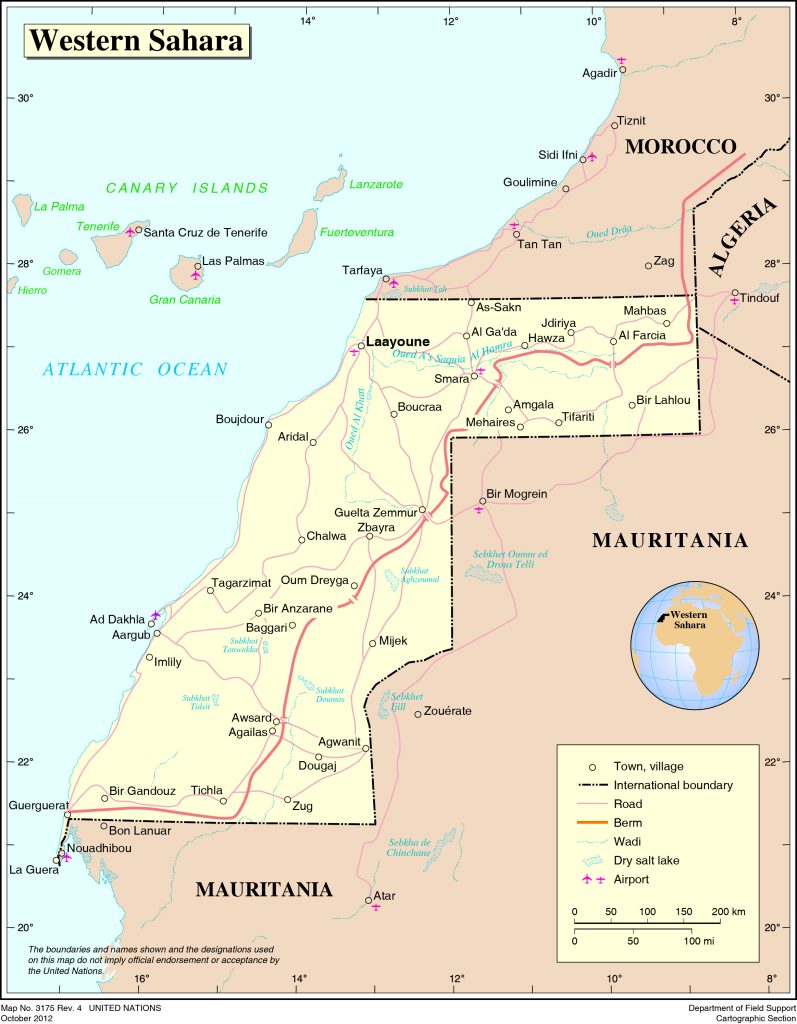
The talks scheduled in Madrid on February 8, 2026, carry enormous symbolism: the conflict arose with Spanish colonization (since 1884, with tribal agreements that respected Sahrawi culture, religion, and way of life) and should be resolved with Spain as the de jure administering power. These talks, promoted by the United States and held at the U.S. Embassy in Madrid, include Morocco and the Polisario Front (the two conflicting parties), Mauritania and Algeria (the two observer countries), in addition to the Personal Envoy of the Secretary-General, Staffan de Mistura, and likely several representatives from the U.S. administration (including figures like Massad Boulos, representative for Africa for President Donald Trump, and Michael Waltz, Ambassador to the UN), aiming to advance a solution to Africa’s longest-running conflict.
It should be recalled that, after Spain’s admission to the UN (1955) and international pressure (Resolution 1514), Spain included the Sahara on the list of Non-Self-Governing Territories (1963). In 1974, it accepted the referendum after compiling a Sahrawi census, but Moroccan and allied pressure led to the request for an ICJ Advisory Opinion (Resolution 3292 (XXIX), 1974), without prejudice to the Sahrawi people’s right to self-determination. The ICJ (October 16, 1975) confirmed that the territory was not terra nullius and that there were no ties of sovereignty precluding self-determination.
However, Spain signed the illegal and null Madrid Tripartite Agreements (November 14, 1975), illegal and void under international law (prohibition of acquisition of territory by force), handing over the territory to Morocco and Mauritania. This provoked the mass withdrawal of the Sahrawi population (75% in refugee camps or diaspora, according to point 156 of the EU Court of Justice ruling of January 15, 2025), napalm and white phosphorus bombings, and war crimes confirmed by the Spanish National Court’s Indictment Order (April 9, 2015, Judge Pablo Ruz) against high-ranking Moroccan military officials accused of genocide.
After Mauritania’s withdrawal from Río de Oro following the Algiers Agreement, signed with the Polisario Front in 1979, UN General Assembly Resolution 3437 (XXXIV) was issued, condemning the persistent Moroccan occupation and its expansion into the part evacuated by Mauritania.
Despite multilateral efforts (1988 OAU/UN Peace Plan, MINURSO 1991), Morocco has deliberately blocked the process, often relying on the acquiescence and even complicity of Spain and other Security Council states (France and the USA).
In 2025, Resolution 2797 (2025) prioritizes a purported Moroccan autonomy, but the Polisario insists that this does not resolve the decolonization status nor nullify the Sahrawi right, calling for non-participation in negotiations that legitimize the occupation.
Conclusion: Unavoidable Questions on Human Rights and Implementation Guarantees
The Madrid talks must address these legal foundations before Spanish and world public opinion, explaining the failures of previous attempts (Moroccan blockages of the referendum, non-compliance with the 1991 Settlement Plan, and systematic and persistent violations) and proposing real avenues for a just and definitive solution that should include: immediate and unconditional release of political prisoners, clarification of the fate of the disappeared Sahrawis, cessation of drone attacks against civilians in the liberated territories of the SADR, announcement of a ceasefire, dismantling of the mined wall, withdrawal of occupying forces, impartial voter identification, and a UN and AU-supervised referendum with clear options (independence, integration, or genuine autonomy).
In 2024-2025, human rights violations in the occupied territories have intensified, with reports from Sahrawi and international organizations, such as Human Rights Watch documenting repression against Sahrawi activists, including arbitrary arrests, torture, and violent dispersal of peaceful protests; Amnesty International reports violent dispersal of Sahrawi women’s demonstrations in El Aaiún and intimidation against human rights defenders (February 2024); meanwhile, NOVACT/ACAPS details trends of property destruction, forced expropriations, and economic discrimination against Sahrawis, with over 100 violations recorded throughout 2024.
Given Morocco’s track record of failing to comply with international commitments —Human Rights Treaties and 1949 Geneva Conventions (applicable to occupation, with documented violations in repression, forced disappearances, extrajudicial executions, arbitrary detentions, torture…), 1991 Settlement Plan (blocking the referendum despite its initial acceptance) and AU Constitutive Act (respect borders inherited from colonialism and resolve disputes peacefully, principle of non-aggression against member states)— unavoidable questions arise:
- How to guarantee that any agreement respects the inalienable right to self-determination of the Sahrawi people, when Morocco has repeatedly rejected the referendum it itself proposed?
- What effective mechanisms of international supervision (UN, AU, independent observers) will be implemented to prevent new non-compliance, given the history of blockages and human rights violations in the occupied territories, as documented throughout the fifty years of occupation against the Sahrawi civilian population?
- Will the serious human rights violations (repression, forced disappearances, extrajudicial executions, arbitrary detentions, torture) documented by Sahrawi and international organizations be addressed, and how will the protection of the Sahrawi population under any future formula be ensured, especially in the face of intensified bombing of civilians in the liberated territories, expropriations, and economic discrimination in 2024-2025?
- Will Spain, as the de jure administering power and origin of the conflict, assume its historical responsibility to promote a just solution, repairing the damage caused by the Madrid Agreements and the 2022 shift, considering its continued control over Sahrawi airspace and its support for the Moroccan plan?
Only a solution based on strict respect for international law and the free will of the Sahrawi people can end this prolonged occupation, avoiding greater harm for all parties, including the Kingdom of Morocco.