Today, February 27, 2026, the Sahrawi people and all lovers of peace and justice commemorate the 50th anniversary of the proclamation of the Sahrawi Arab Democratic Republic (SADR). Since its birth, the SADR has been the guarantor and main bulwark of our people and their legitimate national rights.
This historic milestone filled the political and legal vacuum left by the Spanish State after its unilateral withdrawal from the territory in 1975, thereby failing to fulfil its legal obligation as administering Power to decolonize Western Sahara. This territory, included since 1963 in the United Nations list of Non-Self-Governing Territories, continues to appear on that list as one of the 17 remaining cases of decolonization in the world.
The proclamation of the SADR took place while the resounding conclusions of the United Nations Visiting Mission to Spanish Sahara were still resonant. That mission recognized the Polisario Front as the dominant political force in the territory and recorded the categorical rejection by the Sahrawi people of any territorial claim by Morocco and Mauritania. The report of the United Nations Visiting Mission to Spanish Sahara, approved on October 10, 1975 — exactly 20 days before the start of the Moroccan invasion — was fundamental to the decolonization process of the region. Its main conclusions determined that the overwhelming majority of the Sahrawi population overwhelmingly desired independence and firmly opposed the annexationist ambitions of its neighbors.
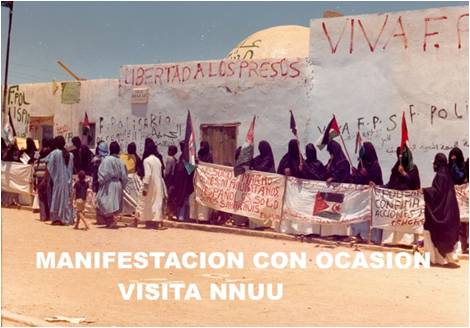
This was reinforced, above all, by the clear Advisory Opinion of the International Court of Justice of October 16, 1975, which stated categorically:
“The materials and information presented to the Court do not establish any tie of territorial sovereignty between the territory of Western Sahara and the Kingdom of Morocco or the Mauritanian entity. Thus the Court has not found legal ties of such a character as might affect the application of General Assembly resolution 1514 (XV) in the decolonization of Western Sahara and, in particular, of the principle of self-determination through the free and genuine expression of the will of the peoples of the Territory.”
Despite this ruling, Morocco and Mauritania invaded the territory with the complicity of Spain. The ensuing Moroccan occupation has constituted, ever since, a systematic and deliberate attack against the Sahrawi civilian population, which Spanish justice has qualified as genocidal. In the historic ruling of April 9, 2015, Judge Pablo Ruz of Spain’s National Court ordered the prosecution of eleven senior Moroccan military and police officials for genocide committed between 1975 and 1992. The ruling describes “bombing of civilian camps, forced displacements, murders, illegal detentions, enforced disappearances and torture”, with the aim of destroying in whole or in part the Sahrawi people as an ethnic and national group.
The SADR is therefore not merely a symbol: it is the bastion and the highest expression of the will of the Sahrawi people. It is a founding member of the African Union (admitted in 1982 to the then OAU) and, since 2017, sits on equal footing with the Kingdom of Morocco in all African summits, in African Union-European Union dialogues and in the TICAD conferences.
The tragedy of Western Sahara tragically evokes the image of a Germany divided by the Berlin Wall. Today, the Moroccan “wall of shame”, more than 2,700 km long and sown with anti-personnel mines, separates families, prevents free movement and perpetuates the forced division of our people. Likewise, our cause has evident parallels with East Timor, which was also invaded in 1975 following Portugal’s withdrawal and finally recovered its independence through the legitimate exercise of the right to self-determination.
The exercise of this inalienable right may include any agreed political formula, including broad autonomy. However, for it to be legitimate, the Sahrawi people must have the real, free and uncoerced possibility of also choosing independence in a referendum organized and supervised by the United Nations, as it has been demanding for decades.
It is imperative that the international community demand strict compliance with international legality, the end of colonialism in all its forms and the inalienable respect for the right of peoples to self-determination. Only the full implementation of the 1991 Settlement Plan — accepted by both parties and endorsed by the United Nations Security Council — will allow a just and lasting solution. To achieve this objective, it is more than necessary to make effective progress in the implementation of the decisions, opinions and recommendations of the main United Nations mechanisms: the Committee against Torture, the Working Group on Arbitrary Detention and the Committee on Enforced Disappearances.
In a special and priority manner, AFAPREDESA demands the immediate and unconditional release of all Sahrawi political prisoners, true living symbols of peaceful resistance and of the dignity of the Sahrawi people. The majority of them were arbitrarily detained since November 2010 during the violent eviction of the Gdeim Izik camp by the Moroccan occupation forces and remain imprisoned in inhuman conditions, turned into hostages of the illegal occupation.
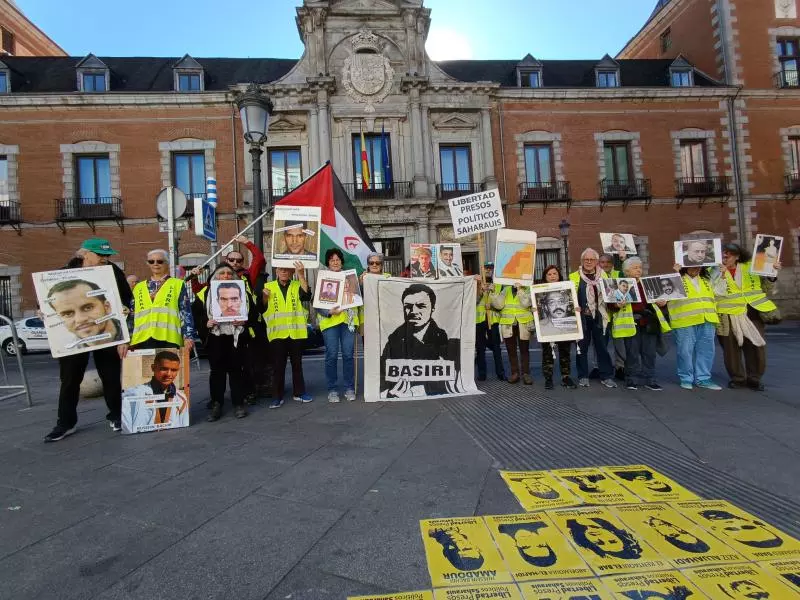
We also demand the immediate clarification of the 445 cases of disappeared Sahrawis, with the urgent exhumation of mass graves and the return of the remains to their families; the definitive end to the bombing of civilians with drones; and the restitution of all confiscated lands and properties.
On the occasion of 50th anniversary of this glorious proclamation, AFAPREDESA pays a vibrant tribute to all the victims of this cruel occupation, which could not have continued without the encouragement, support and active complicity of Spain and the European Union.
Finally, AFAPREDESA makes an urgent appeal to the media to provide truthful and balanced coverage, giving voice to the Sahrawi people, the first and main party concerned. It is necessary to highlight the serious human rights violations that are committed daily in the occupied territories: enforced disappearances, bombings of civilians, arbitrary detentions and torture. Ignoring these facts, which have been judicially recognized as constituting genocide, only serves to prolong an illegal occupation that has already lasted half a century.