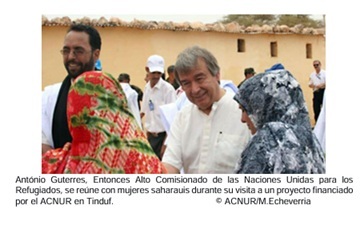
“We recognise that we have not done enough. The Sahrawis have been forgotten for too long, both by the international community and by ourselves.”
— António Guterres, then United Nations High Commissioner for Refugees, during his visit to the Sahrawi refugee camps, 9 September 2009 (source:elmundo.es).
On this World Refugee Day, the Association of Families of Sahrawi Prisoners and Disappeared (AFAPREDESA) pays tribute to the Sahrawi refugees, the oldest refugee population in Africa. Nearly fifty years after the beginning of their exile, more than 200,000 Sahrawis remain in five camps near Tindouf, Algeria, a host country whose unwavering solidarity and sustained efforts to welcome and protect Sahrawi refugees on its soil, we commend. This constitutes one of the most protracted refugee crises in the world.
When armed conflict broke out in the mid-1970s between the Sahrawi resistance fighters and the Moroccan invasion forces, a large part of the population of Western Sahara fled the hostilities to seek refuge in Algerian territory. The Moroccan aggression was accompanied by war crimes, crimes against humanity, mass enforced disappearances, massacres, mass graves and the brutal separation of families by a sand wall laced with antipersonnel mines. These grave human rights violations continue to this day and demand the urgent establishment of an independent international commission of inquiry, as well as the criminal prosecution of all those responsible.
Dramatically insufficient and steadily declining humanitarian aid
Sahrawi refugees depend almost entirely on international aid. Yet, despite growing needs, this aid remains far below the international humanitarian standards defined by the SPHERE standards, UNHCR and WFP:
- Acute malnutrition among children aged 6 to 59 months has increased, exceeding 10% in recent years, accompanied by alarming rates of anaemia (over 50%) and stunting.
- Nearly 80% of families live in severe or moderate food insecurity.
- Food rations have been reduced on several occasions due to chronic underfunding by donors.
- Access to safe drinking water remains well below the minimum requirement of 15 litres per person per day.
- Malnutrition care does not meet standard humanitarian targets.
This situation turns a political crisis into a silent humanitarian catastrophe, confirming Mr Guterres’ very words in 2009: the Sahrawis have indeed been “forgotten” by the international community.
At the same time, the European Union is taking part in the plundering of natural resources and currently applies de facto trade agreements with Morocco that include the resources of Western Sahara, without the consent of the Sahrawi people and their legitimate representative, the Polisario Front. These actions stand in flagrant contradiction to the rulings of the Court of Justice of the European Union and international law.
Historical and current responsibilities to be assumed
Spain, as the de jure administering power, bears particular responsibility for having failed to complete the decolonisation process, as evidenced by the null and void Madrid Accords of 1975. The international community, the African Union and the United Nations must now honour their obligations:
- Respect the inalienable right of the Sahrawi people to self-determination;
- Urgently and substantially increase humanitarian aid.
AFAPREDESA calls for:
- An immediate and significant increase in humanitarian aid — food, health, water, education, shelter — to meet international standards.
- An end to impunity for the crimes committed and strengthened protection of refugee rights.
- The resumption of a credible political process under the auspices of the United Nations and the African Union leading to the holding of a self-determination referendum.
- Strict compliance, by the European Union and all States, with international law and the rulings of the the African Court on Human and Peoples’ Rights and the Court of Justice of the European Union concerning Western Sahara.
Fifty years of exile and neglect is too long. Sahrawi refugees do not ask for charity: they demand justice, dignity and the full and complete exercise of their legitimate rights.
Chahid El Hafed, 20 June 2026